Photograph Pushkar Camel Fair and Kolayat Mela
Rajasthan has to the be one of the most atmospheric states of India and this unique travel photography tour visits many of the undisputed highlights, as well as a number of less well known, but incredibly evocative places. We first ran this trip a few years ago, and it was such a great success that we have only made a few changes – mainly finishing in the lakeside city of Udaipur.
This adventurous photography expedition is timed for the Kartik Poornima full moon, and one of the great religious fairs of India - the Pushkar Mela, also known as the Pushkar Camel Fair. This ancient festival sees pilgrims flocking to holy Lake Pushkar for ritual bathing, and a vast livestock market where thousands of camels are traded. We also visit the little known Kolayat Mela near Bikaner, a religious gathering that attracts pilgrims and Indian sadhus from all over the region.
This varied itinerary sees us stay in many historic properties that conjure up memories of when Rajasthan was ruled by Maharajas. It will also include extensive photography support from professional travel photographer, Steve Davey, countless photo opportunities and the company of fellow photography enthusiasts.
Our journey starts in the capital of Delhi, before we head to the so-called pink city of Jaipur, which is famed for its ornate palace and the massive Amber Fort on a rugged hillside outside of town.
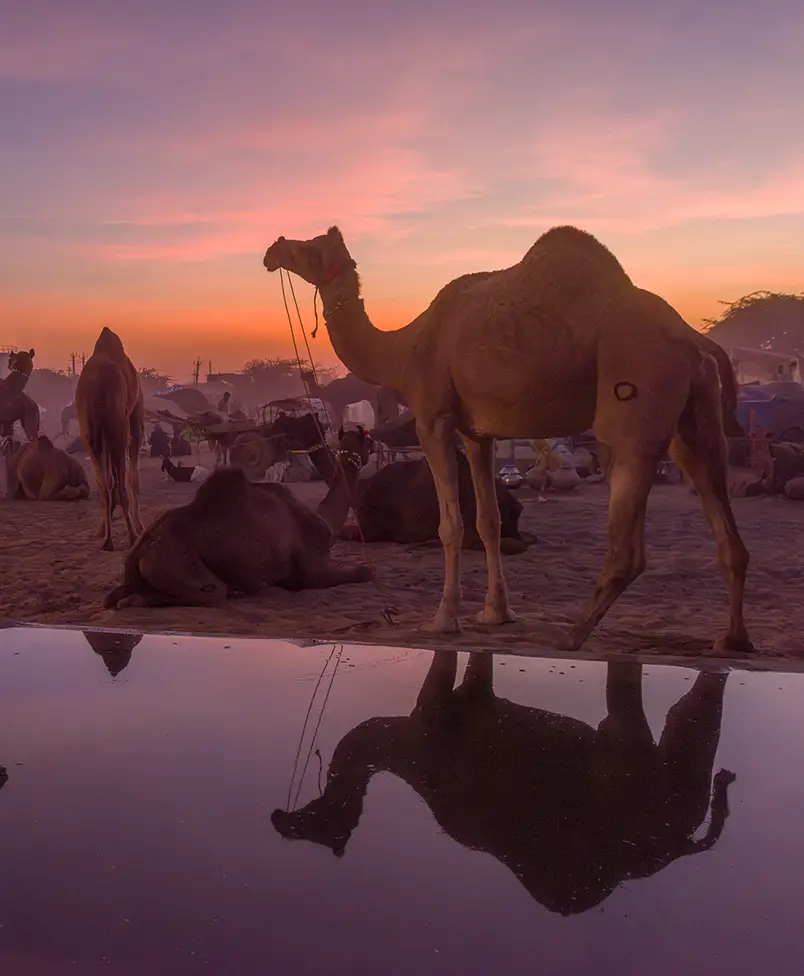
From here we head deeper into the desert, to the holy town of Pushkar, where will be able to witness camels and pilgrims at the iconic Pushkar Mela. There is a vast fairground here too, with a bewildering array of sideshows and attractions.
We have timed our visit to see the maximum number of camels which should be spread across the desert as far as the eye can see.
Although there are vast and fascinating cities all over India, you see the real life of the country in the smaller towns and villages. After Pushkar we head to the traditional Rajasthani Shekhawati region, where we can explore many of the ornate murals that can still be found on the walls of merchant's houses, known as havelis.
From Shekhawati, we drive to the desert town of Bikaner and yet another stunning fort. We will also visit the Camel Research Centre, before heading to the Gajner Palace, on the outskirts of town. This former hunting palace for the Maharaja of Bikaner sits on a lake and is a perfect base to explore the vibrantly religious Kolayat Mela.
This ancient religious gathering is also known at the Kapil Muni mela and attracts a large number of sages or Indian Sadhus. You may even encounter someone performing a standing penance: staying on their feet for twelve years! When we visited a couple of years ago we were the only tourists at this festival, and although that may well have changed slightly, it is certainly well off the beaten track, and chance to witness a religious festival that is relatively unchanged by the outside world.
Our next stop is the fabled city of Jaisalmer in the Thar Desert, with one of the only living forts in the World. The second oldest fort in India, dating back to 1156, the Golden Fort has seen countless battles over the years – sometimes ending in women and children committing Jauhar or ritual suicide whilst the menfolk rode out to certain death on the battlefield.
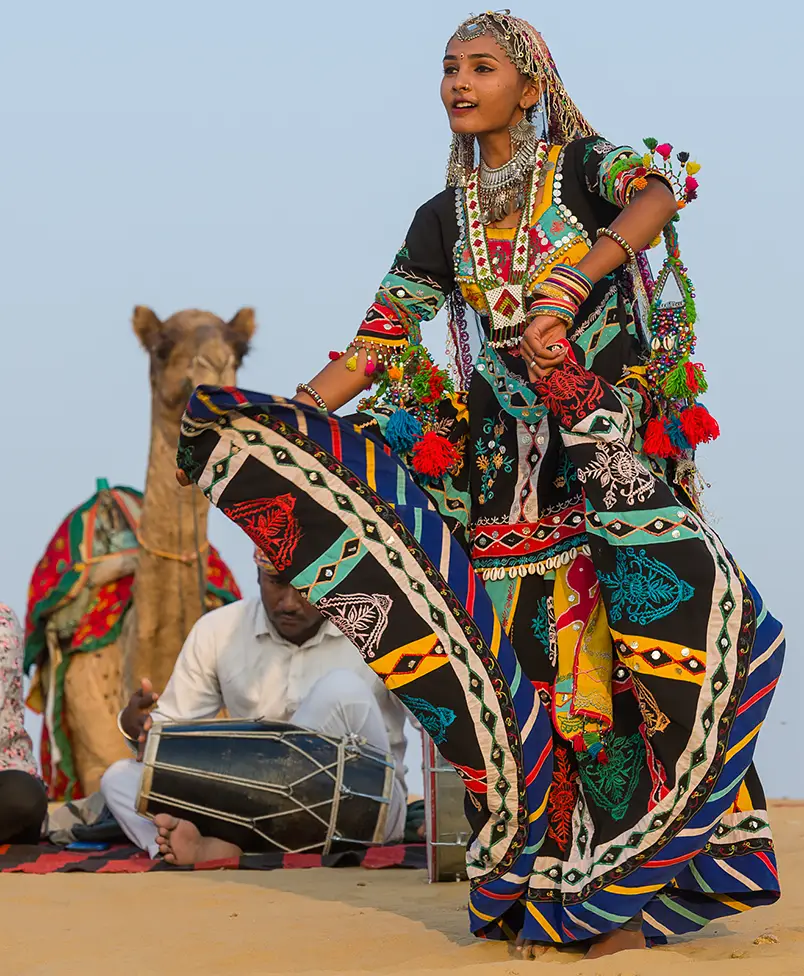
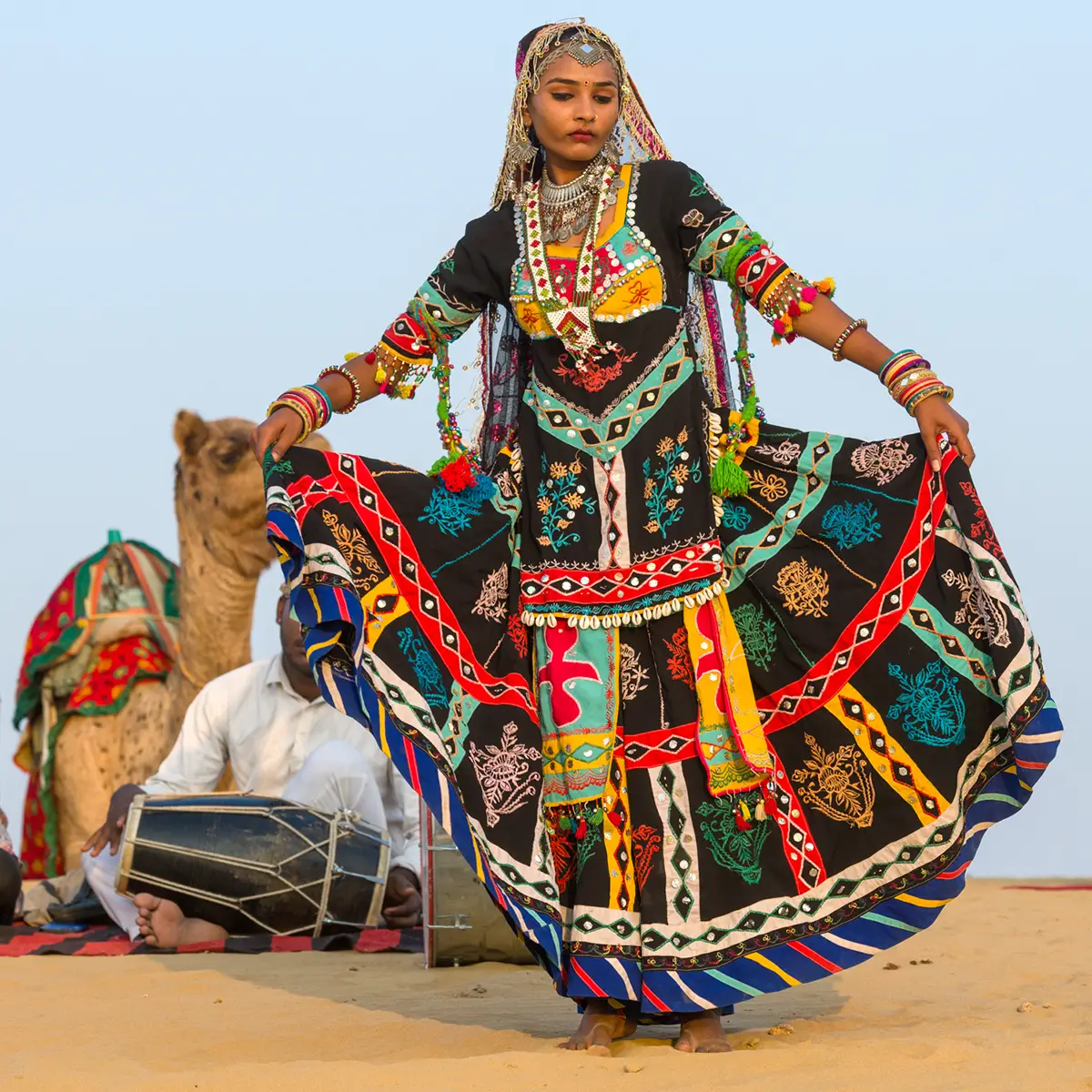
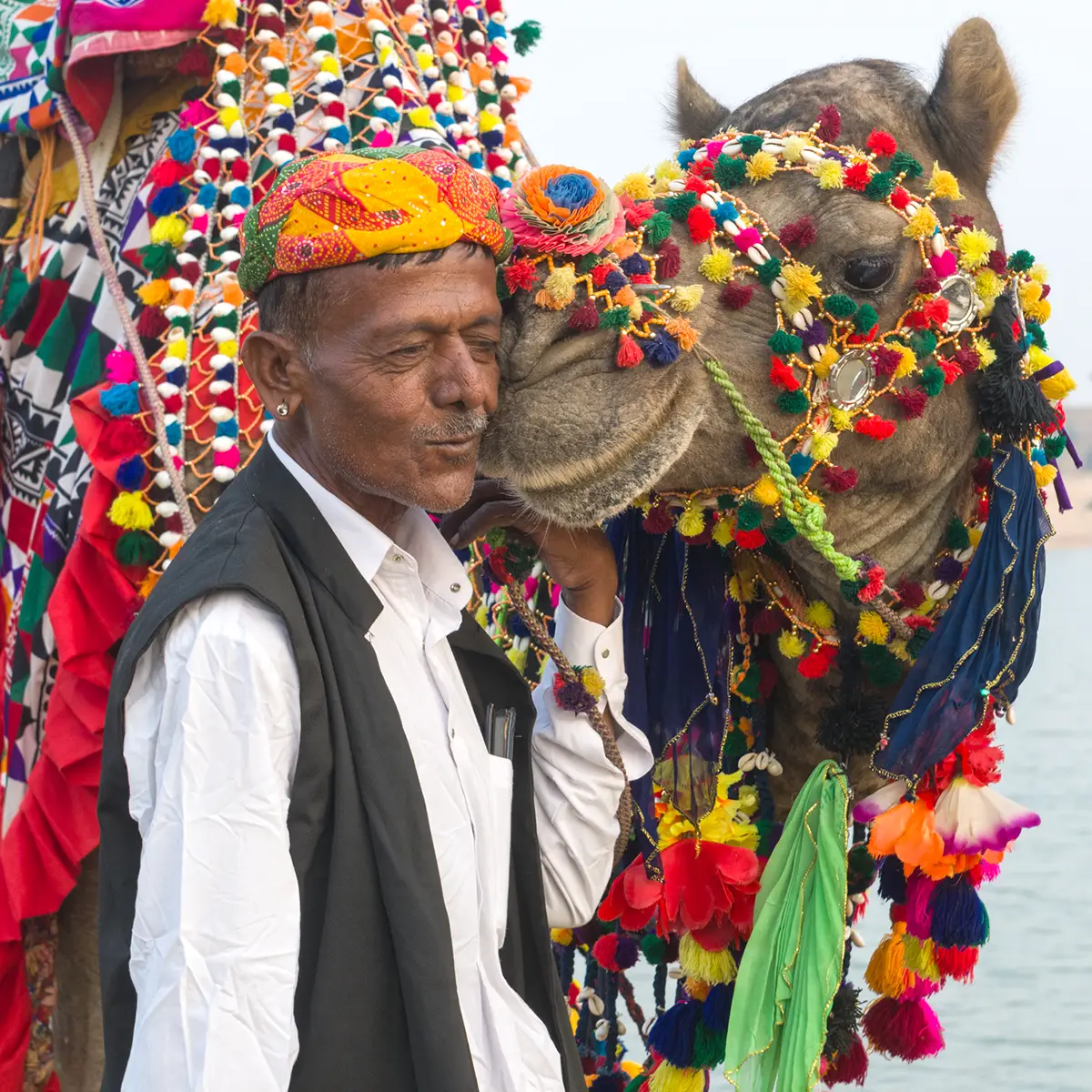
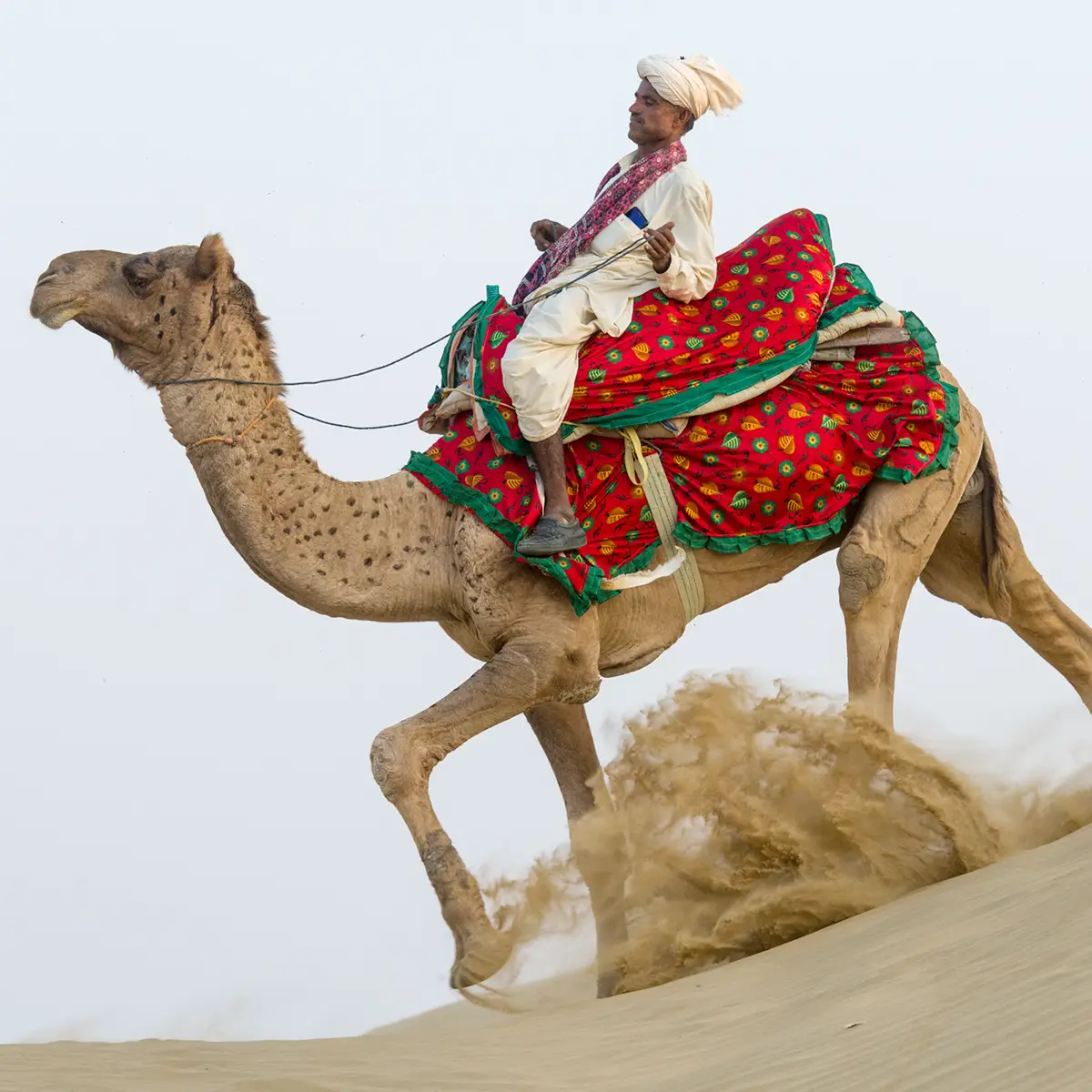
In Jaisalmer we will have a special meal in the desert, organised by the son of an old friend of mine, with traditional musicians and dancers and some elaborately decorated camels to photograph.
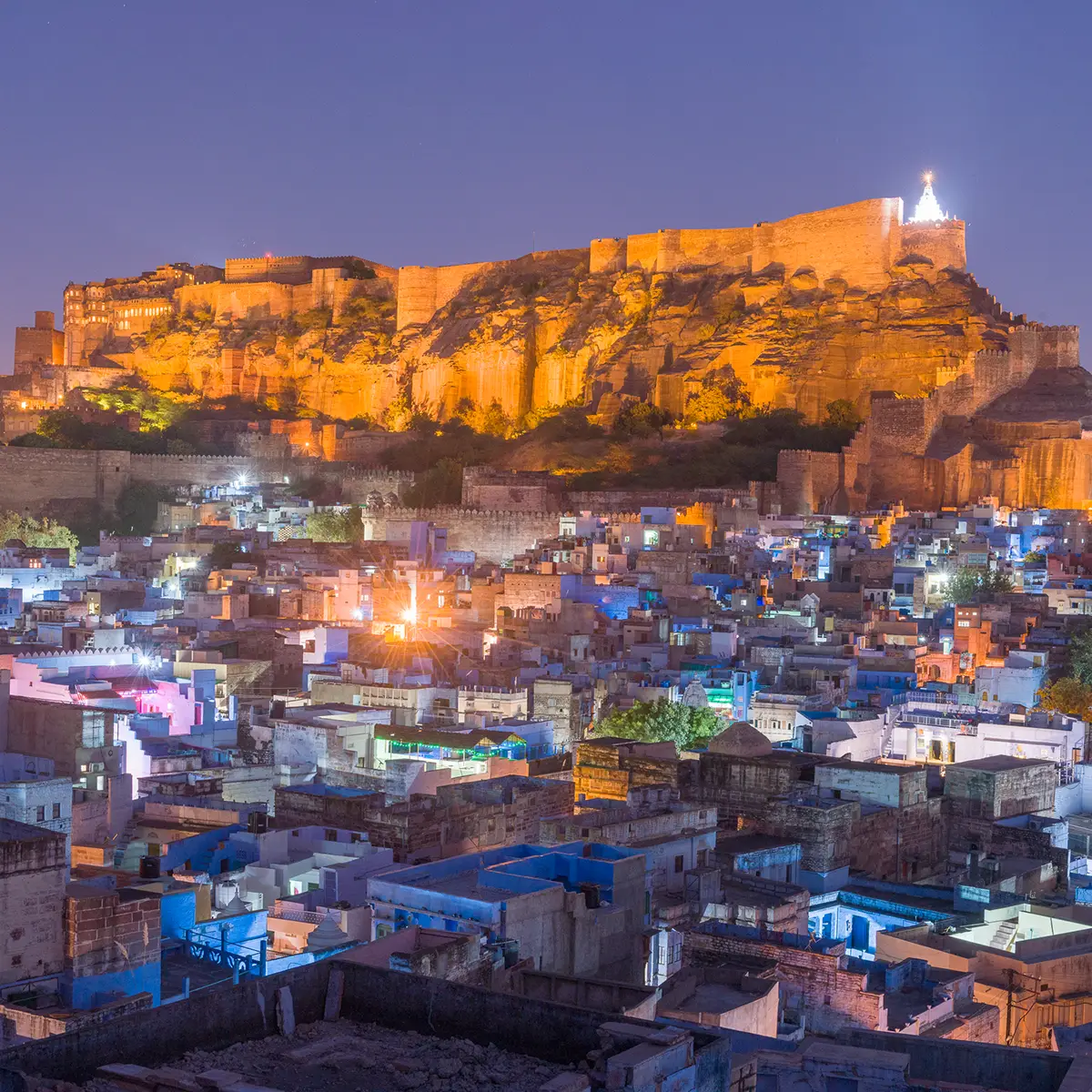
Our penultimate stop is the stunning city of Jodhpur, with what has to be the most spectacular forts in Rajasthan towering above an atmospheric blue town – a neighbourhood where all of the dwellings are painted blue. We will head to a favourite rooftop where we will be able to photograph the fort at sunset, and then at night.
Make sure that you batteries are well charged for our departure from Jodhpur: we will be starting by visiting the Bishnoi tribe, who venerate all living creatures – especially demoiselle cranes and blackbuck deer who both live in a nearby sanctuary. Then we will call at the intricate Jain Temples at Ranakpur – hopefully in time for a simple temple meal.
The afternoon will see us walk a small fraction of the 36 kilometre walls of the Kumbhalgarh Fort (second only to the Great Wall of China) before continuing on to the lakeside city of Udaipur: a long, but spectacular day!
Udaipur will be more relaxed. This lakeside town is a beautiful end to this trip, and we will be able to explore the ornate lakeside palace, take a boat trip on the lake itself and walk some of the atmospheric backstreets before this adventurous tour ends.
Why I think this tour is unmissable
I have been running photography tours for almost 20 years, and have been working with Intrepid Travel for a similar time. In fact the very first photography tour I ever ran for them was to the Pushkar Camel fair in 2006.
On that tour I first worked with the same Intrepid Leader that will be leading this trip: the incomparable Chetan. Between us, Chetan and myself are massively experienced at creating photo-opportunities as we travel through Rajasthan and finding interesting things for everyone to photograph. In the past this has included brick works, water wheels and even gatecrashing the odd wedding!
Rajasthan is one of the most colourful and fascinating states of India, with a rich cultural history. Once ruled by a series of independent Rajput Kingdoms, each ruled by a Maharajah, and centred on an immense Fort or Palace, or in some cases both. Many of these Forts and Palaces can still be seen and are an atmospheric reminder of times gone by.
On this trip, we don't just visit palaces and forts, we will also explore many small and more tucked away locations. This might be a series of ancient Jain temples at Ranakpur, historic painted buildings in the Shekhawati Region or bustling markets and backstreets.
There are wildlife opportunities on this trip too. We will seek out rare Blackbuck and Demoiselle Cranes – both held as sacred by the Bishnoi People near Jodhpur.
On this trip we stay at a range of heritage and eclectic properties, including havelis (merchants' homes), former stately homes and a Maharajah's palatial Hunting Lodge. In these places, your room will be a fascinating part of the whole experience.
Our trip is timed to coincide with two incredible festivals. The Pushkar Camel Fair sees pilgrims and camel traders flock to the desert town of Pushkar, with it's holy lake – one of the most revered locations in Hinduism. There are a number of Indian Sadhus, or holy men who live in ashrams next to the lake, and as you walk through the the desert that surrounds the town, you will see nomadic encampments and camels stretched as far as you can see, under the rising or setting sun.
The Kolayat Mela is less well known and barely sees any tourists compared to Pushkar. Far more traditional it also attracts bathing pilgrims, a fairground and a number of Indian Sadhus who will give out blessings in return for a small donation.
What characterises my approach to travel and photography is a drive to experience as much as possible and to engage with people that we meet with empathy and humour. I will encourage you to do the same – and to photograph your own photographic vision of Rajasthan – rather than pushing you into endless canned photo-opportunities using paid models. The aim is that you will develop your own photographic style and will learn to approach subjects for yourself – which will help you on future travels.
My approach to travel will also ensure that you have a fantastic time whilst travelling too. You will immerse yourself into the culture of Rajasthan and learn a considerable amount about its traditions and history, sample the varied food and also enjoy a lot of laughs in the company of like-minded people; whilst coming home with more great pictures than you ever thought possible.
I hope that you decide to join me on this adventure.
Steve Davey
Photography opportunities
There are a number of incredible things that you will be able to experience and photograph on this trip. We have created the itinerary to give you as many real, and organic things to photograph as we can fit into our time away. We are also able to include pretty much anything that you find interesting as we pass. This might be visiting a brickworks, photographing people working in a field or even watching people make jaggery from sugar cane.
Some of the photographic opportunities you will enjoy on this trip include:
- Chandni Chowk, Delhi - Bustling market in the Old Town
- Amber Fort & Palace, Jaipur - Stunning hillside fort and ornate Palace
- City Palace and Hawa Mahal, Jaipur - Iconic Palace of Winds
- Jantar Mantar, Jaipur - Historic stone astronomical observatory
- Evening Aarti Prayers, Pushkar - Prayers and fire by Pushkar Lake
- Camels in the desert, Pushkar - Sea of camels at sunrise and sunset
- Traditional Fairground, Pushkar - Fairground rides and traders
- Sadhus at Pushkar Lake - Portraits of Indian holy men
- Camel Traders - Portraits of Camel traders in their desert camps
- Marwar Horses, Nawalgarh - Stable of local thoroughbred horses
- Painted Havelis, Shekhawati - Historic painted buildings
- Rural life and people - Portraits of people in Shekhawati
- Jungarh Fort - Incredible fort in the centre of Bikaner
- Camel Breeding Farm - Returning camels at Camel research centre
- Gajner Palace - Former Maharajah's hunting Palace by lake.
- Pilgrims at the Kolayat Mela - Portraits at traditional festival
- Sadhus at ashrams, Kolayat Mela - Portraits of holy men
- Bhang drinkers - Blessing intoxicant drink for religious rituals
- Sunset view of Fort, Jaisalmer - Sunset view of the fort
- Jaisalmer Ramparts -Explore the walls and alleys of the fort
- Jaisalmer Havelis - Ornate traditional houses in the old town
- Dancers, Musicians & Camels - Sunset meal in the desert dunes
- Camels at Gadisar Lake - Photographing decorated camels at sunrise
- Sadi Bazar, Jodhpur - Traditional market and clocktower
- Sunrise view of Fort, Jodhpur - Unique view over the town and fort
- Mehrangarh Fort - Explore the soaring fort towering over the town
- Jaswant Thada, Jodhpur - Exquisite funeral cenotaph
- Blue Town, Jodhpur - Traditional blue painted streets of Jodhpur
- Mehrangarh Fort by night - Photograph fort at dusk from a rooftop
- Bishnoi Villagers - Portraits of traditional tribal peoples
- Demoiselle Cranes & Blackbuck - Migratory birds and rare deer
- Ranakpur Temples - Ornately carved Jain Temples
- Kumbhalgarh fortifications - Stunning fort walls
- City Palace, Udaipur - Beautiful Palace overlooking lake
- Lake Pichola - View from hotel and boat trip on the lake
- Atmospheric backstreets - life in the hidden alleyways of Udaipur
Impressions of Rajasthan photography tour
- full details
Below you can find all of the details about Steve Davey, who has organised and will be leading this tour, Intrepid Travel, who will be handling the land arrangements and bookings, as well as the full price information, dates and what is included in the trip price; and the full itinerary.
Impressions of Rajasthan
17 November to
1 December 2026
Places left: 4*
*Includes held places
Min 8, max 12 people
Variable price from:
8 pax £2695 pp
9 pax £2650 pp
10 pax £2595 pp
11 pax £2550 pp
12 pax £2495 pp
excl. flights, based on roomshare
Price is variable depending on the number of people booked on the trip. You should be prepared to pay the 8 person price; refunds will be processed once the final numbers are confirmed.
Optional single supplement: £795
Although you can opt for a roomshare place, and we will do our best to find someone for you to share with, if this is not possible and you have to have a room to yourself, then unfortunately the single supplement will be payable.
Included in the trip price
- 14 nights hotel
- 14 breakfasts, 1 lunch and 4 dinners
- Group arrival transfer
- Jaipur - Amber Fort entrance
- Jaipur - Panna Meena Stepwell
- Jaipur - City Palace entrance
- Jaipur - Hawa Mahal entrance
- Jaipur - Jantar Mantar entrance
- Pushkar Mela visits
- Nawalgarh - Haveli visit and Walking Tour
- Bikaner - Junagarh Fort entrance
- Bikaner - Camel Breeding Farm
- Kolayat Mela visits
- Jaisalmer - Orientation Walk
- Jaisalmer - Gadisar Lake
- Jaisalmer - Jaisalmer Fort entrance
- Jaisalmer - Haveli Visit entrance
- Jaisalmer - Sunset desert meal
- Jaisalmer - Sunset dancers & Camels
- Jodhpur – Orientation Walk
- Jodhpur - Mehrangarh Fort entrance
- Jodhpur - Jaswant Thada entrance
- Jodhpur - Bishnoi Village visit
- Ranakpur - Jain Temples entrance
- Kumbhalgarh - Kumbhalgarh Fort
- Udaipur - City Palace entrance
- Udaipur - Lake Pichola Boat ride
- Group departure transfer
- All transport as per itinerary
- English Speaking leader
- Entrance fees as per itinerary
- Expert photographic support
Not included in the trip price
The following things are not included in the trip price:
- International Flights
- Any visas required
- Services not mentioned in the itinerary
- Late check out at hotels
- Meals/drinks not mentioned in the itinerary
- Drinks with included lunches and dinners
- Tips for leaders, guides and drivers
- Expenditure of personal nature
- Personal Insurance
- Optional activities
Although international flights aren't included in the trip price, you can opt to have Intrepid Travel buy these for you which gives you a greater level of industry protection, and if your journey starts and finishes in the UK the trip can be covered by an ATOL certificate.
Rajasthan Photography tour - Full Itinerary
The full itinerary of our unique travel photography tour to Rajasthan in India, and the incredible Pushkar Camel Fair and Kolayat Mela, with land arrangements and comprehensive travel industry ATOL protection by Intrepid Travel; led by professional photographer, Steve Davey.
Namaste! Welcome to India!
Arrive at Indira Gandhi International Airport and transfer to your hotel. Standard Check in time at the hotel 14:00 Hours
Situated in a strategic position on the west bank of the Yamuna River, between the Himalayas and the Aravalli Hills, Delhi is the gateway to the rich alluvial soils of the Ganges plain and has, according to Indian folklore, been occupied since 2500 BC.
The original city, Indraprastha was the first of nine. Shahjahanabad or Old Delhi, the 7th city, was built when the Mughal Emperor moved his capital back to Delhi from Agra in 1638.
Planned out in blocks with wide roads, residential areas and bazaars, Chandni Chowk, now thought to be Asia’s busiest street, was the main artery. Literally translated as ‘Silver Street’ this bustling market area of Old Delhi is good for hunting down new and antique gold and silver jewellery from craftsmen whose forefathers served the emperor. At the 1911 Delhi Durbar, King George V announced that the capital of India was to move from Calcutta to Delhi. Inaugurated in 1931, the ambitious work of British architects Sir Edwin Lutyens and Herbert Baker, New Delhi is an audacious statement of Imperial British control over India.
We don't spend much time in Delhi, or have any organised sightseeing, in order to maximise the time we actually get to spend in Rajasthan, but if you wish to arrive early and look around, Intrepid Travel can organise extra nights accommodation for you in advance of the trip.
In evening we will have our welcome meeting and then venture out for welcome dinner at local restaurant. Overnight stay at hotel.
Arrival transfer:
Included on Group flight basis only
Accommodation: Jaypee Siddharth Hotel or similar
Meals included: Dinner
Morning post breakfast, check out and we drive to city of Jaipur in Rajasthan.
Popularly known as the Pink City, Jaipur (City of Victory) is the state capital and largest city of Rajasthan. It was founded by Sawai Jai Singh II in 1727 and was planned according to Indian ‘Vastu Shastra’ principles. The city was divided into 9 blocks representing the ancient Hindu map of the universe; 2 blocks housed the state buildings and palaces, the other 7 allotted to various public buildings. A fortification wall was built around the city with 7 gates for entry. Originally, the buildings were painted in a variety of colours but in 1853 when Prince Albert visited, the old city was painted pink, a traditional colour of welcome. It has remained pink ever since.
Upon arrival visit to the Amber Fort & Panna Meena Kund Stepwell. Set on a hilltop overlooking Maota Lake, the fort is an authentic example of Rajput architecture and the Sheesh Mahal (Hall of Mirrors) is one of its more spectacular buildings. Post visit head to hotel for our overnight stay.
Special information: Our travel time today will be approximately 5 hours
Included activities:
• Jaipur – Amber Fort
• Jaipur – Panna Meena Stepwell
Accommodation: Narain Niwas or similar
Meals included: Breakfast
This morning we head out to visit the sights of Jaipur City Palace, which was constructed by Maharaja Sawai Jai Singh II, reflecting a fusion of Mughal and Rajput architecture. The City Palace complex is spread over a large area occupying one seventh of the old city of Jaipur. It has a sequence of gardens, buildings and courtyards, temple and museum to give it a grand view that reflects its historical importance and magnificent royal grace.
Later we visit Hawa Mahal, also known as “Palace of Winds”, which was built in 1799 as an extension to the Royal City Palace. It allows the royal ladies who at the time strictly observed 'purdah', to be able to watch any processions and activities on the street without being seen by the public. We also visit the Jantar Mantar, an observatory with a collection of astronomical instruments built in order to measure time.
After our morning sightseeing, we depart Jaipur and drive to Pushkar. Upon arrival we will head out to explore the Pushkar fair, and hopefully view the evening aarti prayers down by the side of the lake. Please be aware that Pushkar is considered so holy that the entire town is both dry and pure vegetarian.
Special information:
Our travel time today will be approximately 3 hours
Included activities:
• Jaipur – City Palace
• Jaipur – Hawa Mahal
• Jaipur – Jantar Mantar
Accommodation: Gulaab Niwas Palace or similar
Meals Included: Breakfast
Today we will head out early and spend a full day exploring the Pushkar Mela. Pushkar Fair is the largest camel fair in India and brings almost 50,000 animals together in the town, including thousands of camels that give the festival its popular name of the Pushkar Camel Fair.
The Pushkar Mela is an annual festival celebrated around the full moon night of Kartik (based on Hindu calendar). Kartik Purnima is an auspicious day in the entire country. It is believed that if someone takes a holy bath on the day of the full moon then that person receives special blessings.
There are some organised events put on by the tourist board, along the lines of turban-tying and tourist tug of war, but these are generally a dead loss for photography, and organised just for tourists. The best shots happen in the camel encampments on the desert, where the nomadic camel herders camp and also in the sprawling funfair, where you can even see old fashioned Wheels of Death to amuse the pilgrims. There also some ashrams of sadhus, including some of the fearsome naga or naked sadhus, which make for incredible portraits.
The mela lasts for over a week. The maximum density of camels happens at the beginning of the fair, with the bathing happening during the full moon in the holy lake. Pushkar Lake is considered so holy that photography is forbidden by the lake and of the pilgrims bathing, which makes photographing the pilgrimage side of the fair all but impossible. It is also impossibly crowded at the full moon – which is why we are planning on attending the beginning of the mela, to photograph the most camels, and will be heading to the Kolayat Mela to witness the religious bathing.
Included activities:
• Pushkar - Full day exploring the Pushkar Mela
Accommodation: Gulaab Niwas Palace or similar
Meals included: Breakfast
Morning we will have more free to spend more time at the Pushkar mela. Later after lunch we will head deeper into the princely state of Rajasthan to Nawalgarh, leaving the mela behind for a more relaxed village vibe.
This region is known as Shekhawati, and it is noted for the many historic painting on the walls of merchant houses and even temples. Here we can catch glimpses of life in the most colourful of India’s regions – sari-clad women carrying terracotta pots of water, bangles tinkling as they walk. If the sun’s still up, we can take a walkaround the village, meet the locals and interact with them.
We are staying at a traditional palace hotel, which retains the charm and atmosphere of the days when the Maharajahs ruled Rajasthan. This property also has a large stable of the local Marwar horses, which are brought in to their stables at the end of every day.
Special information:
Our travel time today will be approximately 5 hours
Accommodation: Roop Niwas Kothi or similar
Meals included: Breakfast & Dinner
Today we will enjoy a day of exploring the amazing Shekhawati region which is often referred to as largest open art gallery of Rajasthan. The old frescos could be seen throughout the town in buildings and local houses. We will visit the local markets (bazaar) and see the colourful town, exploring the famous ornate havelis, frescos and learn about the history this small town has to offer. We will walk through the narrow lanes, visit a local temple, take a farm walk and even try Mehndi, a local Indian Tattoo.
Included activities:• Nawalgarh – Haveli visit and Walking Tour
Accommodation: Roop Niwas Kothi or similar
Meals included: Breakfast & dinner
Today we travel deeper into the Thar Desert to the fortified town of Bikaner. Bikaner was an important staging post on some of the great caravan routes and thus houses a multitude of bazaars along with an impressive fort and palace. We continue to Junagarh Fort and explore this 20th century old fort.
We will also visit the Camel Breeding Farm (ICAR-National Research Centre on Camel), established by the Central government. Explore the on-site museum to learn about the developmental and research aspects of Camels in the desert ecosystem. The camels are returned to the centre en masse at the end of the day, which is a spectacular sight.
After the Camel Breeding Farm we will head out to our hotel, which lies on the road to the Kolayat Mela. This is the GajnerPalace, which is a former hunting lodge for the maharajas of Bikaner. It sits on a lake in the middle of a wildlife area, surrounded by ancient trees.
Special information: Our travel time today will be approximately 6 hours
The Camel Breeding Farm is open for visitors 1400 Hours to 1800 Hours
Included activities:
• Bikaner – Junagarh Fort
• Bikaner – Camel Breeding Farm
Accommodation: Gajner Palace or similar
Meals included: Breakfast
A full day to visit Kolayat mela and explore the festivities. Leave your hotel early in the morning and visit the Ghats to see the different types of rituals performed by the devotees. The 51 Ghats surrounded by the Kolayat Lake is similar to the Ghats of Varanasi and this is one of the biggest fairs of this region.
There is a belief if this festival that a great Sage Kapil Muni once performed meditation in order to achieve salvation from mankind. So, this makes it an important sight for the locals, and they perform prayers and rituals at the Ghats. In the evening, the Ghats are lit by earthen lamps and there is an evening Aarti ceremony.
Photography is likely not to be possible of the bathing, but there will be plenty of things to see and photograph around the lake shore and in the narrow streets of the town. This will include the ashrams of sadhus, or Indian holy men that are attracted to the festival. One characteristic of this festival is the religious drinking of Bhang, a marijuana-based drink that pilgrims bless and then drink in vast amounts as a part of their worship.
Included activities:
• Kolayat Mela - full day exploration
Accommodation: Gajner Palace or similar
Meals included: Breakfast
Today, there is the chance of another morning visit to Kolayat mela to further explore the festival, before departing for the long but atmospheric drive to Jaisalmer. Watch as it rears its head in the arid, flat desert like a scene from 'One Thousand and One Nights'. Explore the snaking alleyways of Jaisalmer which are filled with markets and intricately carved houses. Upon arrival, venture out for the leader led orientation walk around the old town and down to the Gadisar Lake.
Special information:
Our travel time today will be approximately 6 hours
Included activities:
• Jaisalmer – Orientation Walk
• Jaisalmer – Gadisar Lake
Accommodation: Hotel Rupal Residency or similar
Meals included: Breakfast
This morning visit the Jaisalmer Fort. Within the fort itself is a maze of houses, temples, shops and restaurants, not to mention some 3,000 permanent residents. Track down some dazzling Rajasthani fabrics, marvel at the spectacular facades of the Patwa ki Haveli and Salim Singh-ki-Haveli. Or you may wish to simply wander the labyrinthine paths and soak up the atmosphere.
In the afternoon we will drive into the dunes for a desert experience to a picturesque location where you can spend time taking photographing at sunset. I have arranged a special dinner in the desert with the son of an old friend of mine, who used to run camel safaris in the Thar Desert. We will have a decorated camel to photograph at sunset and some local musicians and dancers as we eat a local meal under the stars. After our desert experience, we will return to our hotel for the night.
Included activities:
• Jaisalmer – Jaisalmer Fort
• Jaisalmer – Haveli Visit
• Jasialmer – Desert Meal and entertainment
Accommodation: Nachna Haveli or similar
Meals Included: Breakfast & Dinner
This morning you will have the chance to get up for sunrise and photograph a couple of decorated camels at the lake in front of Jaisalmer Fort, and maybe have one last walk around the fort before breakfast. After this, we will drive across the desert to discover Rajasthan's second-largest city, the frenetic Jodhpur. Jodhpur abounds in antique shops and, according to many a traveler, has the best lassi in India. It's also where the famous Jodhpur riding trousers originated. We will explore the Sadar Bazar and the clock tower in the city. The local markets are here famous for its colourful jootis (footwear), turbans and handicrafts.
Upon arrival check in at hotel and evening venture out for leader led walking tour of city.
Special information:
Our travel time today will be approximately 6 hours
Included activities:
• Jodhpur – Orientation Walk
Accommodation: The Mandore or similar
Meals included: Breakfast
Our day in Jodhpur to explore the so-called blue city starts with visit the colossal Mehrangarh Fort, which sits atop a sheer rocky ridge in the middle of town. We’ll explore the looming fortress and the series of palaces within it which narrate a saga of hard sandstone yielding to the chisels of many skilled sculptors. The Jodhpur Museum located within the fort is known for its exceptional collection of palanquins, howdahs (decorated riding seats for camels and elephants) and other interesting artefacts.
Later we will visit the Jaswant Thada: a royal cenotaph built in the memory of Maharaja Jaswant Singh II. This white marble memorial is adorned with exquisite carvings and intricate detail. Built like a temple, the Thada is a testament of the skill of the Jodhpuri sculptors. In the afternoon and evening we will explore the town further, including finding a rooftop in order to be able to photograph the Mehrangarh Fort at night.
Included activities:
• Jodhpur – Mehrangarh Fort
• Jodhpur – Jaswant Thada
Accommodation: The Mandore or similar
Meals included: Breakfast
Today is going to be a long day, but one that will be full of delights! We will start early and venture out for an excursion to a Bishnoi village which is famous for its local tribal people. We will meet and interact with the villagers and take a walk through the local streets. These community believes in revering nature, and here you will get a chance to see migratory birds like demoiselle cranes, blackbucks and chinkaras. Bishnoi men have a unique turban which classifies them different from the other nearby communities.
Next start our journey towards Udaipur. Enroute we stop at Ranakpur to visit the magnificent Jain temples. Nestled in the heart of the stunning Aravalli Hills, Ranakpur is one of the five holy Jain sites and a popular pilgrimage centre. Built in the 15th century, the temples are beautifully crafted and well preserved.
Post lunch we will pay a visit to the sprawling Kumbhalgarh fort. A gem of Rajput legacy in the royal state of Rajasthan, Kumbhalgarh is a fortress town that has the second-longest wall in the world, after the Great Wall of China. A UNESCO World Heritage Site, the Kumbhalgarh Fort lies within the Kumbhalgarh Wildlife Sanctuary that was the erstwhile hunting grounds of the rulers of Mewar. The birthplace of the legendary Rajput ruler, Maharana Pratap, Kumbhalgarh was one of the most prominent fortresses of Mewar. Later we continue our drive to Udaipur. Upon arrival check in at hotel for our overnight stay.
Special information:
Our travel time today will be approximately 5 hours
Included activities:
• Jodhpur – Bishnoi Village
• Ranakpur – Jain Temple
• Kumbhalgarh – Kumbhalgarh Fort
Accommodation: Lake Pichola Hotel or similar
Meals included: Breakfast & Lunch
This morning we venture out to visit City Palace perched on a hill by Lake Pichola, is an architectural marvel built in 1567. It consists of four major palaces and several smaller ones, connected by courtyards and corridors. Enter through the iconic Tripolia Gate to explore highlights like the Rai Angan, the oldest part of the palace, and the Mor Chowk, adorned with intricate peacock mosaics. Later enjoy a serene sunset cruise on Lake Pichola. Surrounded by hills, palaces, and temples, the lake is home to the magnificent island palaces of Jag Mandir and Jag Niwas, followed by farewell dinner at the Lakeside Restaurant.
Included activities:
• Udaipur – City Palace
• Udaipur – Boat ride at Lake Pichola
Accommodation: Lake Pichola Hotel or similar
Meals included: Breakfast & Dinner
There are no other activities planned for the day. Standard Check out time at the hotel is 11:00 Hours. For those who wish to stay in Udaipur to further explore the city, we are happy to help in booking accommodation (subject to availability).
Departure Transfer:
• Included on Group flight basis
Meals included: Breakfast
Although we have set out an itinerary above, there are always a number of gaps and things that are organised on the ground. One of the things that we specialise on my trips is wringing the most photo-opportunities out of our time away. You will get to do everything on the itinerary, but as well as this there will be all sorts of things that we will include as we go.
In essence, this is the basis of all of our trips: it is not just the things that are listed on the itinerary that are the things that people remember, we are always seeking out things to stop for, engage with and photograph, and there are a number of times when we have built in time to be flexible. This might be calling in to a brickworks or an old fashioned water-mill as we drive past, or organising an impromptu (optional) morning start to find a viewpoint for sunrise.
When we have 'free time' on the itinerary, I will always be heading out to do something and you will, of course, be more than welcome to join me.